
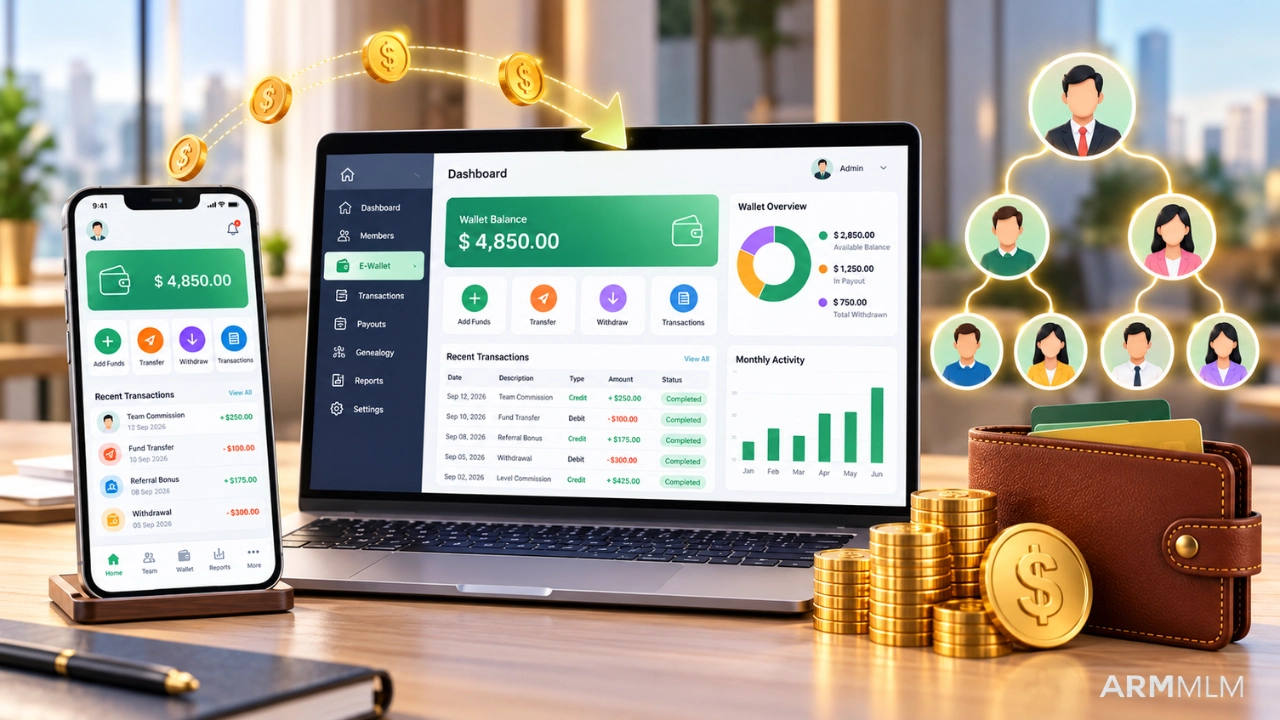
Managing money across a growing MLM network can become complicated when commissions, bonuses, purchases, transfers, and withdrawals are handled through separate processes. An E-wallet for MLM brings these activities into a centralized digital wallet system, making it easier for distributors and administrators to manage eligible funds.
Instead of relying on manual payment records, an MLM e-wallet allows members to receive commissions, use their wallet balance for purchases or upgrades, transfer funds, and request withdrawals through a unified platform.
For MLM companies looking to simplify financial operations and improve the distributor experience, an integrated e-wallet can become an important part of their MLM software infrastructure.
What Is an E-Wallet for MLM?
An E-wallet for MLM is a digital wallet integrated into MLM software that allows distributors to store and manage their earnings and other eligible funds within the platform.
The wallet can be connected with the company’s compensation plan and financial workflows. When a distributor earns a commission or bonus, the eligible amount can be credited to their wallet. The balance can then be used for supported transactions such as product purchases, membership payments, transfers, or withdrawals.
From the administrator’s side, the e-wallet provides a centralized way to track wallet activity and manage financial transactions across the network.
In simple terms:
MLM activity → Commission or bonus → E-wallet credit → Wallet transaction or withdrawal
Why Do MLM Businesses Need an E-Wallet?
MLM businesses can have thousands of distributors performing different financial activities every day. Commissions may come from multiple income streams, while members may also make purchases, pay fees, transfer funds, or request payouts. Managing these activities manually can create unnecessary administrative work. An e-wallet integrated with MLM software can help bring these activities into one system.
Centralized wallet management
Distributors can view their available balance and transaction history from their back-office dashboard instead of depending on separate payment records.
Faster commission access
When commissions are processed according to the compensation plan, eligible earnings can be credited directly to the distributor’s wallet.
Simplified internal transfers
If the business allows member-to-member transfers, distributors can send eligible wallet funds to another account within the MLM ecosystem.
Convenient purchases
Wallet balances can be used for approved purchases such as products, memberships, subscriptions, or account upgrades.
Organized payout management
Distributors can submit withdrawal requests while administrators review, approve, reject, or process them according to the company’s payout rules.
How Does an E-Wallet Work in MLM Software?
The exact workflow depends on the MLM business model, compensation plan, payment integrations, and financial policies. A typical e-wallet workflow can be structured into five stages.
-
- Earnings Are Generated
A distributor earns commissions or bonuses based on qualifying activities defined by the MLM compensation plan.
- Funds Are Credited to the Wallet
After the applicable calculations and validations, the eligible amount is credited to the distributor’s e-wallet.
- Distributor Uses the Balance
The distributor may use available wallet funds for supported activities such as product purchases, membership payments, upgrades, or internal transfers.
- Withdrawal Is Requested
When a distributor wants to cash out, they can submit a payout request through their account.
- Payment Is Processed
The administrator or automated payout workflow processes the request through the configured payment method or gateway, subject to the company’s rules and applicable requirements.
Common E-Wallet Transactions in MLM Software
A well-designed MLM e-wallet can handle different types of financial transactions within a single platform, giving distributors and administrators greater control over network payments and earnings. Common transactions include:
Wallet Credits
Funds can be added to a distributor’s wallet through eligible commissions, bonuses, refunds, approved deposits, or other configured credit sources.
Wallet Debits
Wallet balances can be reduced when distributors make purchases, pay fees, transfer funds, or perform other permitted transactions.
Member-to-Member Transfers
An MLM business may allow distributors to transfer eligible wallet balances to other members, subject to configured limits and authorization rules.
Withdrawals
Distributors can request payouts from their available balance through the supported withdrawal process.
Product and Membership Payments
Wallet funds can be used to pay for products, memberships, subscriptions, or upgrades where the MLM business enables these options.
Refunds and Adjustments
Authorized administrators can process applicable refunds, corrections, or wallet adjustments while maintaining a transaction record.
Key Features of E-Wallet for MLM
The requirements of an MLM e-wallet can differ based on the business model, compensation plan, and transaction volume. However, certain capabilities can make wallet management more efficient, transparent, and convenient for both administrators and distributors. Some of the key features to consider include:
Real-Time Wallet Balance
Distributors should be able to see their available wallet balance and understand how much is currently usable.
Detailed Transaction History
Every credit, debit, transfer, withdrawal, refund, and adjustment should have a corresponding transaction record.
Commission Integration
The wallet can be connected to the MLM compensation engine so that eligible commissions and bonuses flow into the appropriate distributor accounts.
Internal Fund Transfers
Businesses can enable distributor-to-distributor transfers when this functionality aligns with their operating model and compliance requirements.
Withdrawal Management
The system can provide a structured process for submitting and managing payout requests.
Admin Wallet Controls
Administrators can review transactions, manage eligible adjustments, configure rules, and monitor wallet activity.
Payment Gateway Integration
An MLM e-wallet can be connected with supported payment gateways and payout providers to facilitate deposits and withdrawals.
Transaction Status Tracking
Wallet transactions can have statuses such as pending, completed, failed, cancelled, or rejected, helping users understand the current state of a transaction.
Security Controls
Authentication, authorization, encryption, audit trails, transaction validation, and other appropriate security measures can help protect wallet operations.
Benefits of an E-Wallet for MLM Businesses
An integrated MLM e-wallet can simplify financial management for both the MLM company and its distributor network. By bringing earnings, payments, transfers, and withdrawals into a centralized system, it can reduce manual processes while giving distributors greater visibility and control over their funds. Some of the key benefits include:
Better Financial Organization
Instead of maintaining separate records for commissions, purchases, transfers, and withdrawals, businesses can bring eligible transactions into one centralized wallet environment.
Improved Distributor Experience
Distributors can access their wallet balance, review transactions, and manage supported payments directly through their MLM dashboard.
Reduced Manual Work
Automated wallet credits and transaction workflows can reduce repetitive administrative tasks.
Faster Internal Transactions
When enabled, wallet-to-wallet transfers can move funds between members without requiring a separate external payment process.
Greater Transaction Visibility
Detailed transaction histories provide administrators and distributors with greater visibility into wallet activity.
Scalable Financial Management
Centralized wallet architecture can make it easier to manage financial activity as the distributor network grows.
E-Wallet for MLM vs. Traditional Payment Management
Traditional MLM payment management may involve spread sheets, separate payment systems, manual commission calculations, and independent payout records. This can make reconciliation increasingly difficult as transaction volumes increase. An integrated e-wallet connects these activities within the MLM software ecosystem.
| Traditional Payment Management | E-Wallet for MLM |
| Separate financial records | Centralized wallet records |
| More manual processing | More automated workflows |
| Limited transaction visibility | Detailed transaction history |
| Separate commission and payout processes | Integrated commission-to-wallet flow |
| Manual reconciliation can be complex | Centralized transaction tracking |
| Limited self-service for distributors | Distributor wallet dashboard |
The purpose of an MLM e-wallet goes beyond simply digitizing payments. It connects commissions, bonuses, purchases, transfers, and withdrawals within the MLM platform, creating a more streamlined financial workflow for both the business and its distributors.
E-Wallet Security Considerations for MLM Businesses
Since an MLM e-wallet handles financial transactions and sensitive account information, security needs to be considered from the initial design stage through implementation and ongoing operation. A secure wallet should incorporate appropriate controls to protect user accounts, validate transactions, restrict unauthorized access, and maintain reliable financial records. Important areas include:
-
- Secure user authentication
- Role-based access controls
- Transaction authorization
- Encryption of sensitive information
- Audit logs
- Fraud and abuse monitoring
- Withdrawal verification
- Transaction validation
- Secure API integrations
- Backup and recovery mechanisms
The wallet should also be designed around the legal, financial, data-protection, and payment requirements applicable to the business’s operating markets.
Payment Gateway Integration with MLM E-Wallets
Payment gateway integration can extend the functionality of an MLM wallet by connecting the platform with external payment infrastructure. Depending on the business model and supported providers, integrations can facilitate activities such as:
-
- Wallet deposits
- Membership payments
- Product purchases
- Subscription payments
- Distributor payouts
- Refund processing
- Payment status synchronization
The exact gateways and payment methods should be selected according to the target market, currency requirements, business model, transaction volume, and applicable regulations.
E-Wallet for MLM Software: Development Considerations
Developing an e-wallet for MLM software requires more than adding a balance and withdrawal option. The wallet should work closely with the compensation plan, payment infrastructure, security controls, and overall MLM workflow.
-
- Wallet Architecture
The wallet architecture should be designed around how distributors will receive, use, transfer, and withdraw funds. It should support wallet balances, transaction records, credits, debits, transfers, and withdrawals based on the business model.
- Compensation Integration
The e-wallet should connect with the MLM compensation engine so that eligible commissions, bonuses, and other earnings can be credited automatically. This helps create a consistent flow from commission calculation to wallet settlement.
- Payment Gateway Integration
Payment gateway integration allows the wallet to support activities such as deposits, product purchases, membership payments, and distributor payouts. The selected payment providers should match the target markets, currencies, transaction volume, and business requirements.
- Security
Security should be considered throughout the development process. User authentication, access controls, transaction authorization, encryption, withdrawal verification, audit logs, and secure API integrations can help protect wallet operations and financial data.
- Transaction Management
Every wallet transaction should have a clear record and status. The system can track credits, debits, transfers, withdrawals, refunds, and adjustments while providing administrators with accurate transaction histories and reconciliation data.
- Admin Controls
Administrators should have appropriate controls for monitoring wallet activity, reviewing withdrawal requests, managing adjustments, configuring transaction rules, and generating financial reports. Role-based permissions can help restrict sensitive wallet functions.
- Scalability
The wallet should be able to support increasing numbers of distributors and transactions as the MLM network grows. A scalable architecture can help maintain reliable performance without requiring major changes to the wallet system later.
A well-planned MLM e-wallet should therefore be developed as part of the broader MLM software ecosystem rather than as a standalone payment feature. Its architecture should align with the compensation plan, payment workflows, security requirements, and long-term business goals.
How to Integrate an E-Wallet with MLM Software
E-wallet integration with MLM software involves connecting the wallet with the systems responsible for compensation, payments, products, withdrawals, and transaction records.
A typical integration flow can look like:
MLM Activity → Compensation Calculation → Validation → E-Wallet Credit → Wallet Transaction → Withdrawal or Purchase
The integration can connect the e-wallet with:
-
- MLM compensation and commission systems
- Distributor accounts and dashboards
- Product and membership transactions
- Payment gateways
- Payout providers
- Withdrawal management
- Transaction reporting
- Administrative controls
For example, when a distributor earns an eligible commission, the compensation engine can calculate and validate the amount before crediting it to the distributor’s wallet. If the distributor uses the balance for a purchase, the wallet transaction can be recorded and synchronized with the relevant product or membership transaction. For withdrawals, the wallet can create a payout request that moves through the configured approval and payment workflow.
ARM MLM can provide an MLM software environment where wallet functionality is integrated with the broader operations of a network marketing business. This allows the wallet to be configured around the company’s compensation model, payment workflows, distributor requirements, and operational processes.
Choosing the Right E-Wallet for MLM Software
Before implementing an e-wallet for MLM, a network marketing company should evaluate more than just the number of features. The right solution should fit the company’s compensation structure, transaction requirements, security standards, and long-term growth plans.
-
- Compensation plan compatibility: Can the wallet work with the commission and bonus structure used by the business?
- Transaction flexibility: Does it support the types of credits, debits, transfers, purchases, and withdrawals the business requires?
- Security: Are appropriate authentication, authorization, transaction controls, and audit mechanisms available?
- Payment integrations: Can the platform connect with the payment gateways and payout providers required in the target markets?
- Scalability: Can the wallet architecture support increasing numbers of distributors and transactions?
- Reporting: Can administrators generate useful transaction and wallet reports?
- Customization: Can wallet rules and workflows be adapted to the company’s MLM model?
Conclusion: E-Wallet for MLM
An E-wallet for MLM can turn complex network payment activities into a more centralized and manageable financial workflow. By connecting commissions, bonuses, purchases, transfers, and payouts within MLM software, businesses can improve transaction visibility while reducing unnecessary manual processes.
For MLM companies planning to scale their network, the right e-wallet architecture should work alongside the compensation plan, payment infrastructure, distributor dashboard, and administrative controls. With ARM MLM, businesses can build an MLM software ecosystem with e-wallet functionality tailored to their operational and financial requirements.
Frequently Asked Questions
1. What is an E-wallet for MLM?
An E-wallet for MLM is a digital wallet integrated into MLM software that allows distributors to receive, store, transfer, and use eligible funds such as commissions and bonuses. It can also support purchases, membership payments, and withdrawals.
2. How does an MLM e-wallet work?
When a distributor earns a qualifying commission or bonus, the amount can be credited to their wallet. The distributor can then use the available balance for supported transactions or submit a withdrawal request according to the company’s payout rules.
3. Can distributors transfer money between wallets?
Yes. MLM software can support member-to-member wallet transfers when the business enables this functionality. Transfer limits, authorization rules, and transaction conditions can be configured based on the company’s requirements.
4. Can an E-wallet be connected to payment gateways?
Yes. An MLM e-wallet can be integrated with suitable payment gateways and payment providers to support activities such as deposits, product payments, membership payments, and distributor payouts.
5. Can commissions be credited directly to an MLM e-wallet?
Yes. An e-wallet can be connected with the MLM compensation system so that eligible commissions and bonuses are credited to the distributor’s wallet after the applicable calculations and validations are completed.
6. Why should an MLM business integrate an e-wallet with its MLM software?
Integrating an e-wallet with MLM software can bring eligible financial activities into a structured workflow, reduce manual processes, improve transaction visibility, and give distributors a convenient way to manage their earnings.