
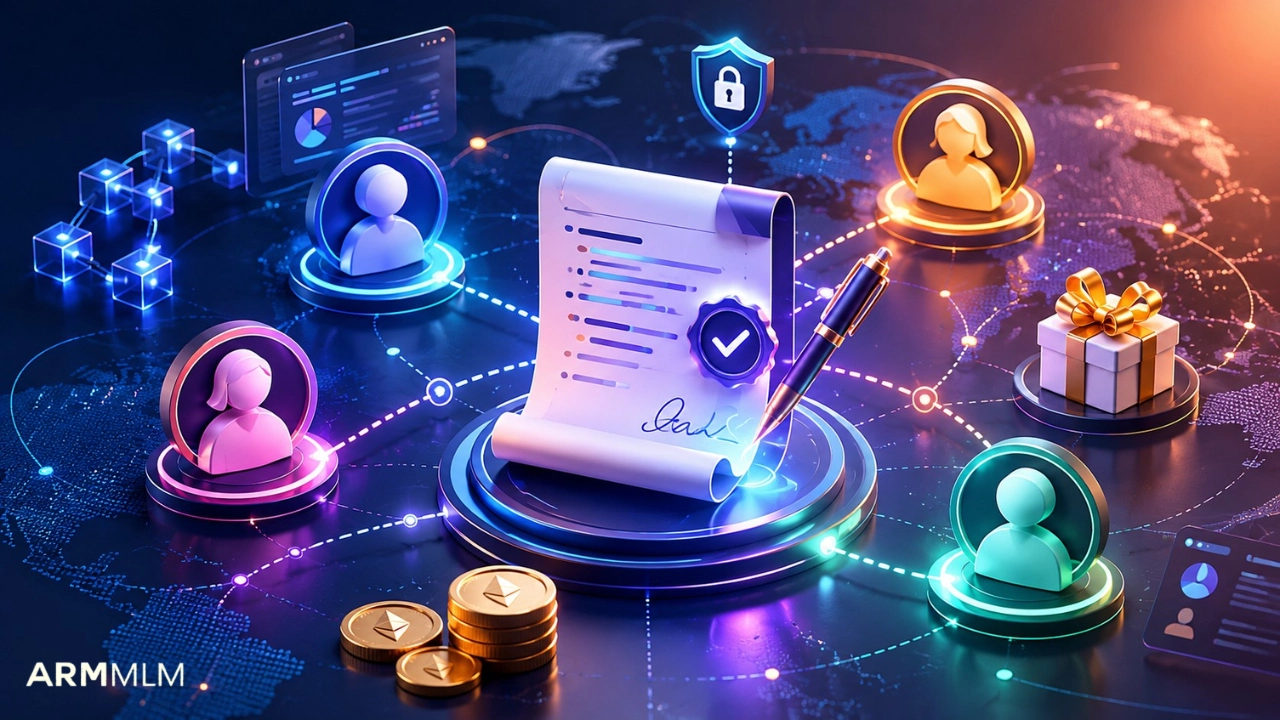
Afghanistan’s digital ecosystem is evolving in a very different environment compared to highly banked economies. Limited financial infrastructure restricted access to international payment systems and growing interest in decentralized technologies are encouraging individuals and small business communities to explore blockchain-based alternatives.
One of the most noticeable developments is the rise of smart contract referral systems built on Binance Smart Chain. These systems automate referral tracking commission distribution and transaction execution directly through blockchain code without relying on centralized software or administrative control.
As mobile crypto wallet adoption continues to grow decentralized referral platforms are gradually becoming part of a broader digital transformation focused on transparency automation and peer-to-peer participation.
Understanding Smart Contract Referral Systems
Smart contract referral systems are blockchain-powered network models where all operational logic is handled through self-executing code. Unlike traditional referral software, these systems do not depend on centralized databases backend servers or manual payout processing.
When users interact with the platform transactions are executed directly through a blockchain wallet such as MetaMask or Trust Wallet. Every referral relationship reward distribution and transaction record is stored permanently on-chain creating a transparent and verifiable system.
In most cases these platforms are built using Solidity smart contracts on Binance Smart Chain because of its lower gas fees faster transaction speed and compatibility with decentralized applications.
Key components of smart contract referral platforms include:
-
- Wallet-to-wallet transactions
- Automated commission distribution
- Blockchain-based referral tracking
- BEP20 token integration
- Decentralized participation models
- Immutable smart contract execution
The biggest difference compared to traditional MLM software is that the blockchain itself becomes the operating infrastructure.
Why Blockchain Referral Platforms Are Gaining Attention in Afghanistan
The growing interest in blockchain referral systems is closely connected to local financial and technological realities. Many individuals and small business operators face challenges when using conventional banking channels especially for cross-border transactions digital payments and network-based income distribution.
Blockchain technology offers an alternative structure where users can participate directly through decentralized wallets without depending on traditional financial intermediaries.
Another major factor is accessibility. Smartphone usage continues to increase and many users are becoming familiar with mobile crypto wallets decentralized exchanges and peer-to-peer payment systems. This creates an environment where blockchain participation feels more practical than traditional financial onboarding.
Several factors are contributing to this growing interest:
-
- Low-cost blockchain transactions
- Reduced dependency on centralized banking systems
- Faster commission payouts
- Transparent on-chain transaction records
- Mobile-friendly participation
- Access to decentralized finance ecosystems
As awareness around DeFi and blockchain automation expands, users are becoming more comfortable interacting with smart contract-based systems.
How Smart Contract Referral Systems Work
At a technical level smart contract referral systems follow a structured automated process. Instead of registering through a traditional website users interact directly with a blockchain contract using their crypto wallet.
Once a transaction is initiated the smart contract automatically records the participant’s referral relationship and places the user within the network structure according to predefined rules.
The system then handles commission distribution automatically. Rewards are transferred instantly to eligible wallets based on coded logic without requiring admin approval or manual processing.
A typical workflow includes:
-
- Connecting a crypto wallet
- Sending a transaction to the smart contract
- Recording referral relationships on-chain
- Assigning users within a network structure
- Executing automated reward distribution
- Verifying transactions through blockchain explorers
Because every activity is recorded publicly participants can independently track reward flow and transaction history.
Popular Types of Smart Contract Referral Models
Different blockchain referral platforms use different compensation structures depending on how the ecosystem is designed. These models determine how users are positioned how commissions flow and how network growth is managed.
Some systems focus on structured placement while others prioritize automated pooling or binary balancing logic. Modern platforms often combine multiple structures to create hybrid compensation ecosystems.
Matrix Model
The matrix model uses a fixed-width structure where users can sponsor a limited number of direct participants. Once positions are filled additional users spill into deeper levels automatically.
This model is commonly used because it creates predictable expansion logic and works efficiently with blockchain automation.
Common matrix structures include:
-
- 2×2 matrix
- 3×3 matrix
- 5×2 matrix
- Forced matrix systems
Some platforms also integrate reinvest cycles and automated upgrades within matrix contracts.
Binary Model
The binary model organizes participants into two network branches referred to as the left leg and right leg. Commissions are usually calculated based on matching volume generated on both sides.
Binary systems are popular because they encourage balanced network activity and continuous engagement.
Core binary features often include:
-
- Left and right leg tracking
- Matching bonus calculations
- Volume-based rewards
- Automated payout execution
- Carry-forward volume systems
Auto-Pool Systems
Auto-pool models focus heavily on automation. Instead of depending entirely on direct recruitment the smart contract automatically places users into a shared global structure.
Rewards are triggered when predefined conditions inside the pool are satisfied.
Auto-pool systems are designed to simplify participation while reducing manual positioning logic.
Unilevel Structures
Unilevel referral systems allow participants to sponsor unlimited direct referrals while earning rewards across multiple depth levels.
These systems are widely used because they are easier for users to understand and scale naturally over time.
Typical unilevel features include:
-
- Unlimited direct referrals
- Multi-level commissions
- Tier-based reward distribution
- Deep network expansion
- Flexible compensation logic
Challenges and Limitations of Smart Contract Referral Systems
Smart contract referral systems introduce a shift toward automated and on-chain execution, but they also bring technical, usability, and regulatory challenges that directly affect scalability and long-term viability. Understanding these limitations is essential before deploying any blockchain-based referral platform.
Immutability of Smart Contracts
One of the primary constraints is immutability in smart contract architecture. Once a Solidity contract is deployed on networks like Binance Smart Chain, its logic becomes fixed, making post-deployment changes difficult.
-
- Permanent execution logic after deployment
- Requires upgradeable contract patterns if flexibility is needed
- High dependency on pre-launch testing and validation
Smart Contract Security and Audit Requirements
Security remains a critical concern because these systems handle automated value transfers. Any vulnerability in the code can be exploited if not properly audited.
-
- Common risks include reentrancy attacks and logic errors
- Necessity of professional smart contract audits
- Secure Solidity development and testing are essential
Modern blockchain platforms increasingly prioritize audited smart contract frameworks and secure development practices to reduce operational risks. Well-tested systems often achieve security scores above 91/100, indicating stronger code quality, optimized gas usage, and improved resistance to common vulnerabilities.
User Experience and Adoption Barriers
User experience remains a major challenge, especially for non-technical participants interacting with blockchain systems for the first time.
-
- Requires familiarity with wallets like MetaMask or Trust Wallet
- Users must manage private keys and approve transactions
- No recovery options for lost credentials or incorrect transfers
Regulatory and Compliance Uncertainty
Regulatory frameworks around blockchain-based referral systems are still evolving, which creates uncertainty for businesses operating in different regions.
-
- Compliance requirements vary across jurisdictions
- Need for a transparent system structure and defined utility
- Risk of legal ambiguity in emerging markets
Sustainability of Tokenomics and Network Design
Long-term sustainability depends on how well the economic model is structured. Systems without real utility may struggle to maintain engagement.
-
- Weak tokenomics can affect platform stability
- Over-reliance on continuous user participation
- Utility-driven models improve long-term viability
Trust and Market Perception
User trust remains a key factor, especially in referral-based ecosystems where skepticism can be high.
-
- Importance of audited and verifiable smart contracts
- Transparent on-chain activity builds credibility
- Clear communication improves user confidence
Why Binance Smart Chain (BSC) Is Preferred for Smart Contract Referral Systems
Binance Smart Chain has become one of the most widely used ecosystems for smart contract referral development because it combines affordability scalability and developer flexibility.
Compared to networks with high gas fees BSC allows users to participate in referral transactions at a much lower cost. This becomes especially important in systems involving frequent payouts upgrades and network interactions. It also supports fast transaction confirmation which improves user experience and real-time commission execution. Key reasons developers prefer Binance Smart Chain include:
-
- Low transaction fees
- Fast block confirmation speed
- BEP20 token compatibility
- EVM support for Solidity development
- Easy wallet integration
- Strong decentralized ecosystem
- Scalable transaction handling
These advantages make BSC highly practical for blockchain-based referral platforms targeting emerging markets.
The Future of Smart Contract Referral Ecosystems
The next phase of blockchain referral platforms will likely move beyond simple commission distribution systems toward broader decentralized ecosystems with real utility integration.
Future smart contract systems may combine referral mechanics with:
-
- Staking platforms
- DeFi utilities
- NFT-based memberships
- Governance systems
- Community-driven token ecosystems
- Decentralized identity models
As blockchain adoption continues to grow the focus will gradually shift toward sustainability transparency and long-term utility rather than pure recruitment-based participation.
In emerging markets this evolution could create new opportunities for decentralized entrepreneurship peer-to-peer digital collaboration and blockchain-based economic participation.
Smart Contract Referral Systems vs Traditional MLM Software
Smart contract referral systems and traditional MLM software share the same goal of managing network growth and commission distribution but differ in execution. Traditional MLM relies on centralized databases admin control and manual or semi-automated payouts while smart contracts use blockchain for automated wallet to wallet transactions without intermediaries.
This impacts transparency cost and user experience. Traditional systems offer flexibility and easier onboarding while smart contract models prioritize decentralization automation and trustless execution. Businesses choose between them based on scalability compliance and long term sustainability.
| Feature | Smart Contract Referral Systems | Traditional MLM Software |
| Infrastructure | Blockchain-based (BSC, Ethereum) | Centralized servers and databases |
| Control | Fully decentralized, no admin control | Admin-controlled system |
| Transparency | Public, on-chain and verifiable | Limited, depends on internal reporting |
| Payout System | Instant wallet-to-wallet transactions | Manual or scheduled payouts |
| Trust Model | Trustless (code-based execution) | Trust-based (company-managed) |
| Flexibility | Limited after deployment (immutability) | High flexibility and easy updates |
| Setup Requirement | No website needed in some cases | Requires website and backend system |
| Security | Depends on smart contract audits | Depends on server and system security |
| User Experience | Requires crypto wallet knowledge | Beginner-friendly with login systems |
| Cost Structure | Lower operational cost (no intermediaries) | Higher due to maintenance and staff |
| Compliance | Complex and evolving regulations | Easier to align with legal frameworks |
| Scalability | High, based on blockchain capacity | Scalable but infrastructure-dependent |
In practice, many businesses are now exploring hybrid approaches—combining the automation and transparency of blockchain with the flexibility and compliance support of traditional MLM systems. This allows them to balance innovation with stability while adapting to different market conditions, especially in emerging digital economies.
Conclusion
Smart contract referral systems are becoming part of a broader transformation in digital networks. By combining blockchain automation, decentralized participation, and transparent reward distribution, they offer a strong alternative to traditional referral software.
In Afghanistan, growing interest in wallet-based ecosystems, DeFi, and blockchain accessibility is driving adoption. However, long-term success depends on secure development, responsible design, and sustainable, utility-driven models.
As the technology matures, these systems are expected to evolve into more scalable and structured digital ecosystems built on trustless infrastructure. Businesses are increasingly evaluating both traditional MLM software and smart contract systems to choose the right approach.
With over a decade of experience in the network marketing industry, ARM MLM supports this transition by delivering secure, scalable, and customizable referral and smart contract solutions for emerging markets.
Get in touch with us today to build your next-generation blockchain-powered referral system and stay ahead in the evolving digital economy.
Frequently Asked Questions
What is a smart contract referral system?
A blockchain-based system that automates referral tracking and commission distribution using self-executing code.
Are smart contract referral platforms safe?
They can be secure if properly audited, but risks depend on contract quality and design.
Why is Binance Smart Chain used for referral systems?
Due to low fees, fast transactions, and strong wallet compatibility.
Can referral systems run without a website?
Yes, some smart contract systems operate entirely through wallet-to-wallet interaction.
What are the benefits of smart contract referral systems?
They offer transparency, automated payouts, reduced operational costs, and tamper-proof on-chain record keeping.
How do users join a smart contract referral network?
Users typically connect a crypto wallet like MetaMask or Trust Wallet and interact directly with the deployed smart contract to join the system.
Related Blogs
 Self Replicating Website: How It Makes Success In MLM Business?
- DeFi MLM Software: Combine Staking Rewards & MLM Growth
- AI MLM Software: How Artificial Intelligence Is Transforming Network Marketing
- How a Commission Calculator Improves Transparency in MLM Payout Systems
- What Role Do Solana Telegram Bots Play in MLM Networks?