
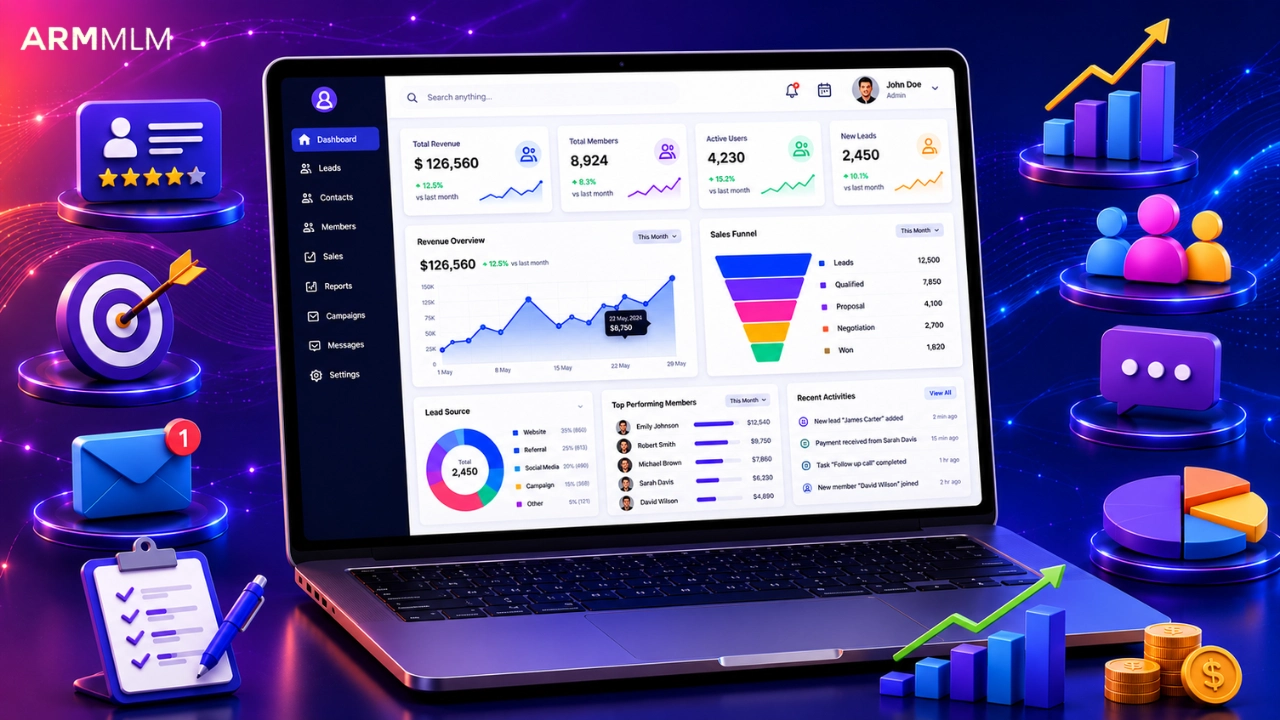
In 2026, running a successful MLM business is no longer just about managing distributors and payouts—it’s about building relationships at scale. As networks grow more competitive, businesses need systems that go beyond basic commission tracking. This is where MLM CRM software becomes essential.
An MLM CRM is not just a contact database—it acts as a central hub to manage distributors, leads, communication, onboarding, and retention. Without it, even well-structured networks face issues with engagement, duplication, and long-term growth.
With 100+ million distributors globally, the difference between a growing MLM business and a stagnant one often comes down to how effectively it manages relationships and data.
This guide will help you understand:
-
- What MLM CRM software is
- Why it matters in 2026
- Key features to look for
- How to choose the right CRM for your network
If you’re aiming to scale efficiently, a strong CRM system is no longer optional—it’s a core part of your growth strategy.
What is MLM CRM Software?
MLM CRM software is a specialized system built to manage distributor relationships, leads, communication, and performance within a network marketing business.
Unlike traditional CRM tools, this model is designed for multi-level structures, where relationships go beyond direct customers and extend across layered distributor networks. This makes it more aligned with how MLM businesses actually operate.
At its core, it acts as a central relationship engine that helps you:
-
- Manage distributor profiles and track their activities
- Monitor leads and conversion progress
- Automate communication and follow-ups
- Track team performance and engagement
- Streamline onboarding and improve retention
Instead of handling these processes manually, the CRM connects everything into a single, structured system. This not only improves day-to-day operations but also strengthens your overall business strategy by supporting consistent growth and better network management.
Why MLM Businesses Need a CRM System in 2026
As MLM businesses grow, managing relationships manually becomes inconsistent and difficult to scale. What works for a small team quickly breaks down when your network expands. A CRM system brings structure, ensuring every distributor and lead is tracked, nurtured, and supported throughout their journey.
In 2026, CRM is no longer a support tool—it’s a core growth system.
Here’s why it has become essential:
-
- Distributor retention depends on engagement
Consistent communication, follow-ups, and support keep distributors active and involved over the long term.
- Lead management improves conversion rates
Organized tracking ensures no prospect is missed, increasing the chances of turning leads into active distributors.
- Duplication becomes easier
With structured onboarding and guided communication, new distributors can replicate proven processes more effectively.
- Data-driven decisions become possible
CRM insights help you understand performance, identify gaps, and refine your growth strategy.
- Scalability improves significantly
Systems can handle thousands of users while maintaining control, consistency, and visibility.
Without a CRM, growth often becomes reactive and fragmented. With the right system in place, your MLM business becomes organized, scalable, and performance-driven.
Key Features of MLM CRM Software
A good CRM in an MLM setup should do more than store contacts—it should support how your network actually works day to day. From handling new leads to keeping distributors engaged, the system needs to bring everything into one smooth workflow.
Here are the features that really matter:
Distributor & Lead Management
You need a clear view of both prospects and active distributors without switching between tools. Keeping everything in one place reduces confusion and helps teams stay organized.
-
- Centralized user database
- Lead tracking with status updates
- Clear visibility from prospect to active distributor
Communication & Automation
Consistent follow-up is what keeps people interested and active. Instead of relying on manual effort, automation keeps communication steady and timely.
-
- Email and SMS campaigns
- Automated follow-up reminders
- Broadcast messages for updates
Onboarding & Training
The easier it is for new distributors to get started, the better your network grows. A structured onboarding flow removes guesswork and builds confidence.
-
- Guided onboarding steps
- Training materials and resources
- Progress tracking for new joiners
Performance Tracking
To improve results, you need to understand what’s working and what’s not. A CRM should give a clear picture of activity and outcomes across the network.
-
- Sales and activity insights
- Team performance tracking
- Conversion and retention data
System Integration
Your CRM should work alongside your MLM software, not separately. When systems are connected, operations become smoother and more reliable.
-
- Sync with commission and payout systems
- Unified view of operations
- Real-time data updates
Mobile Access
Distributors are always on the move, so access shouldn’t be limited to desktops. Mobile-friendly systems help them stay connected and responsive.
-
- Easy access on mobile devices
- Real-time notifications
- Quick updates on the go
When these features are in place, the system naturally supports better coordination, stronger engagement, and steady network growth—without adding unnecessary complexity.
How MLM CRM Improves Network Growth
Growth in MLM is not just about adding more people—it’s about how well you manage and support your network as it expands. Without a system, follow-ups become inconsistent, communication gaps increase, and opportunities are often missed.
A well-implemented CRM brings structure to this process, turning scattered efforts into a consistent and repeatable growth model.
Here’s how it makes a real difference:
-
- Improves lead conversion
Timely and organized follow-ups ensure prospects stay engaged and don’t lose interest midway.
- Enhances distributor engagement
Regular communication, updates, and reminders keep distributors active and involved.
- Simplifies duplication
When processes are clearly defined, new distributors can follow the same steps and replicate results more easily.
- Strengthens team relationships
Better visibility into activities allows leaders to provide the right support at the right time.
- Reduces drop-offs
Consistent onboarding and ongoing engagement help retain distributors for longer periods.
Instead of reacting to problems, a CRM helps you stay ahead by creating a system-driven environment where growth becomes more predictable and manageable.
Build vs Buy: Should You Develop or Purchase MLM CRM?
Choosing between building a custom CRM and buying a ready-made solution depends on your business goals, budget, and timeline. Here’s a simple comparison to help you decide:
| Factor | Build Custom CRM | Buy Ready-Made CRM |
| Development Time | Long (months) | Quick (days or weeks) |
| Cost | High initial investment | Lower upfront cost |
| Customization | Fully customizable | Limited (depends on provider) |
| Maintenance | Requires ongoing technical support | Handled by provider |
| Scalability | Can be built for large-scale needs | Scalable based on plan |
| Risk Level | Higher (delays, technical issues) | Lower (tested solution) |
| Best For | Large businesses with unique requirements | Startups and growing businesses |
What should you choose?
For most businesses, especially those looking to launch quickly and scale efficiently, a ready-made CRM is the practical choice.
Custom-built solutions are better suited for enterprises that need complete control and have the resources to manage long-term development.
Types of CRM MLM Software
Choosing the right type of CRM for your MLM business depends on how your operations are structured, how much control you need, and how quickly you want to scale. Not every system fits every stage, so understanding the core types helps you make a more practical decision.
Here are the three main types:
1. Cloud-Based CRM
Cloud-based systems are hosted online, which means your team can access them anytime, from anywhere. This is especially useful for MLM businesses with distributed teams or global networks where real-time updates matter.
-
- Easy to deploy without heavy infrastructure
- Cost-effective for startups and growing teams
- Real-time access across locations
Best fit: Businesses that prioritize flexibility, mobility, and quick setup.
2. On-Premises CRM
On-premises CRM is installed on your own servers, giving you full control over data, security, and system customization. While it requires more setup and maintenance, it offers a higher level of control.
-
- Greater control over data and privacy
- Customizable to specific business workflows
- Suitable for strict compliance requirements
Best fit: Established MLM companies that need full ownership and tighter security control.
3. Hybrid CRM
Hybrid CRM combines the strengths of both cloud and on-premises systems. It allows partial online access while still maintaining control over critical data locally.
-
- Flexible working environment (online + offline)
- Better reliability across different regions
- Balanced control and accessibility
Best fit: MLM businesses operating across multiple regions, especially where connectivity may vary.
Popular CRM Options for Network Marketing Businesses
Beyond types, it’s also helpful to look at commonly used CRM platforms. Each comes with its own strengths depending on your scale and requirements.
-
- Salesforce
Known for advanced customization, automation, and AI-driven insights. Suitable for large-scale MLM businesses that need deep analytics and complex workflows.
- HubSpot CRM
User-friendly and quick to set up, with strong marketing automation features. Works well for small to mid-sized teams focusing on lead management and communication.
- Zoho CRM
A balanced option offering affordability, customization, and solid reporting tools. Ideal for growing businesses looking for flexibility without high costs.
- ARM MLM Software CRM
Designed specifically for MLM operations, combining CRM features with tools like genealogy tracking and commission management. Suitable for businesses looking for an all-in-one MLM-focused system.
How to Choose the Right MLM CRM Software
Choosing the right CRM is less about picking the most feature-rich option and more about finding a system that fits your workflow and scales with your network. A good CRM should feel easy to use from day one while still supporting long-term growth.
Here are the key areas to evaluate:
Ease of Use
If the system is complicated, adoption becomes a challenge. Both admins and distributors should be able to navigate it without confusion.
-
- Clean and intuitive dashboard
- Simple navigation across features
- Minimal training required for daily use
Automation Capabilities
Automation plays a major role in reducing manual effort and keeping processes consistent. It ensures that leads and distributors are engaged without constant supervision.
-
- Lead nurturing workflows
- Automated follow-ups
- Scheduled communication and reminders
Scalability
Your CRM should not limit your growth. As your network expands, the system should handle increased users and data without slowing down.
-
- Supports a growing user base
- Handles large volumes of data
- Maintains consistent performance
Integration Capabilities
A CRM should not work in isolation. It needs to connect smoothly with your MLM software and other systems to avoid data gaps.
-
- Integration with commission systems
- Payment and wallet synchronization
- Unified reporting across platforms
Security and Compliance
With sensitive distributor and financial data involved, security cannot be overlooked. A reliable CRM should offer strong protection and transparency.
-
- Secure data storage
- Role-based access controls
- Audit logs and activity tracking
Choosing the right CRM ultimately comes down to how well it balances usability, automation, and scalability—while fitting seamlessly into your existing MLM ecosystem.
Common Mistakes to Avoid When Buying MLM CRM
Even with the right intentions, many MLM businesses end up choosing a CRM that doesn’t fully support their growth. The issue is rarely the idea of using a CRM—it’s choosing the wrong one for the business model.
Here are some common mistakes to watch out for:
-
- Choosing a generic CRM not built for MLM
Standard CRM tools often lack support for multi-level structures, making it difficult to manage distributor networks effectively.
- Ignoring integration with MLM software
When your CRM doesn’t connect with your commission or payout system, it creates data gaps and operational inefficiencies.
- Overlooking user experience
A complex or confusing interface can reduce adoption, especially among distributors who need quick and easy access.
- Not planning for scalability
A system that works for a small team may struggle as your network grows, leading to performance issues later.
- Focusing only on cost
Choosing the cheapest option can limit features, flexibility, and long-term usability.
Avoiding these mistakes helps ensure that your CRM supports your business not just today, but as it continues to grow and evolve.
Also Read: Common MLM Mistakes in 2026 & How MLM Software Solves Them
Why MLM CRM + MLM Software is a Powerful Combination
On their own, MLM software and CRM systems solve different problems. One handles structure and commissions, while the other focuses on relationships and engagement. But when they work together, the impact is much stronger.
Instead of managing operations in separate systems, integration brings everything into a single, connected workflow—making the entire business more efficient and easier to scale.
Here’s what that combination delivers:
-
- Seamless operations
Distributor data, commissions, and communication stay aligned without manual syncing.
- Smooth data flow
Information moves across systems in real time, reducing errors and duplication.
- Better distributor experience
From onboarding to earnings tracking, everything feels more connected and transparent.
- Faster, more structured growth
With both operations and engagement working together, scaling becomes more predictable.
When CRM and MLM software are integrated, it creates a complete ecosystem—one that supports both the technical and human sides of your business.
Why Choose ARM MLM Software for CRM-Integrated Solutions
Managing relationships and commissions separately often creates gaps in communication, data flow, and overall efficiency. A unified system solves this challenge by bringing everything into one place, and that’s exactly what ARM MLM Software is designed to do.
ARM MLM combines MLM operations with built-in CRM capabilities, allowing businesses to manage their network structure and distributor engagement within a single platform. Instead of switching between multiple tools, you get a connected system where leads, distributors, communication, and payouts work together seamlessly.
With features like integrated lead and distributor management, automated communication and onboarding, and real-time analytics, businesses gain better visibility and control over their operations. The platform is also built with scalability in mind, making it suitable for both growing networks and established organizations.
Backed by years of experience in MLM technology, ARM MLM Software helps businesses build a more efficient, organized, and growth-ready ecosystem where both operations and relationships are managed together.
Final Thoughts
In 2026, MLM success is no longer just about adding more distributors—it’s about how effectively you manage relationships as your network grows. Businesses that focus on structured engagement and consistent communication are the ones that scale sustainably.
A well-implemented CRM system supports this by helping you:
-
- Convert more leads into active distributors
- Retain your network for longer periods
- Improve overall team performance
- Scale operations without losing control
When combined with the right MLM software, CRM becomes more than just a tool—it turns into a core driver of long-term, sustainable growth.
Planning to implement the right CRM for your MLM business?
Getting the structure right from the beginning can make a significant difference in how your network grows.
Reach out for expert guidance on choosing or building a CRM system tailored to your business:
Frequently Asked Questions
What is MLM CRM software?
MLM CRM software is a system designed to manage distributor relationships, leads, communication, and performance tracking within a network marketing business. It helps organize and streamline day-to-day MLM operations in one place.
Why is CRM important for MLM businesses?
CRM improves lead management, distributor engagement, and retention. It ensures consistent communication and helps businesses scale in a structured way instead of relying on manual processes.
Can MLM CRM integrate with MLM software?
Yes. Modern MLM CRM systems are designed to integrate with MLM software so that commissions, payouts, and user data can be managed in a unified system.
Should I build or buy MLM CRM software?
For most startups and growing businesses, buying a ready-made CRM is more practical due to lower cost and faster deployment. Custom-built solutions are better suited for large enterprises with specific requirements.
What features should a good MLM CRM include?
A strong CRM should include lead management, automation tools, onboarding support, performance tracking, integration capabilities, and mobile accessibility.