

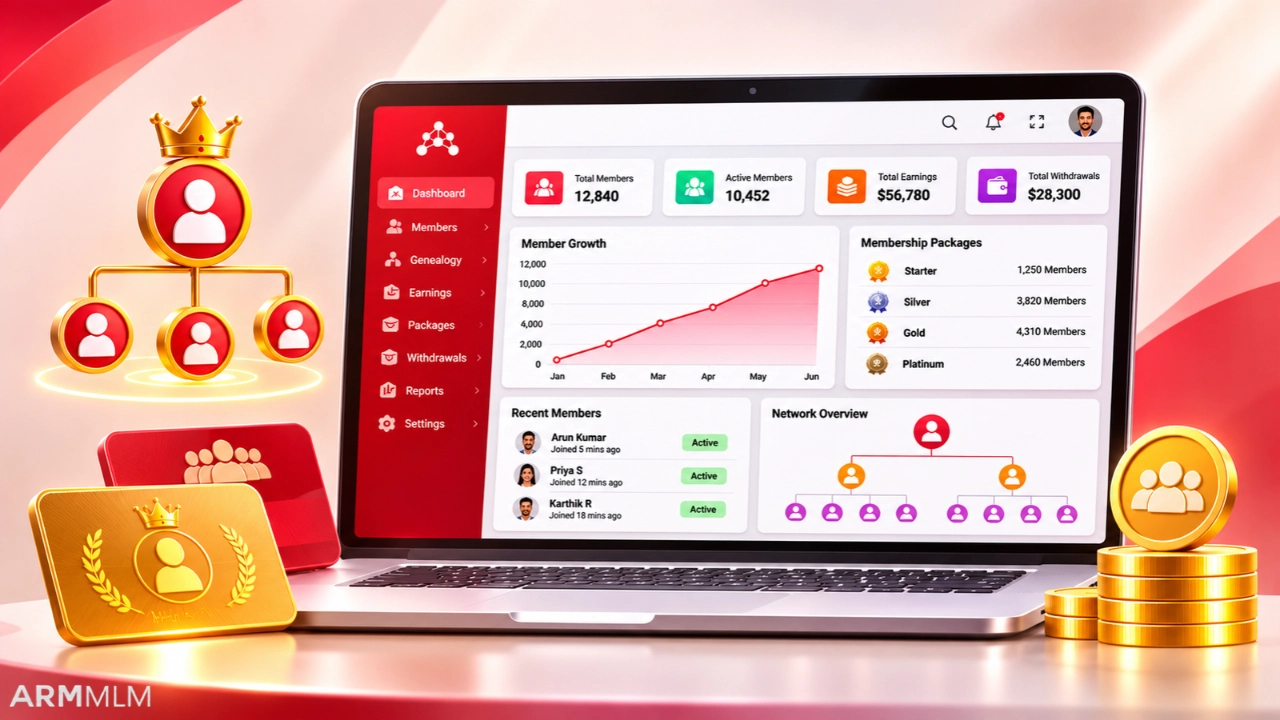
Membership-based businesses often need more than a standard membership management system. When a business combines recurring memberships, referral commissions, team building, and multiple compensation structures, managing these activities manually can become complicated. This is where membership MLM software becomes useful.
Membership MLM software is a specialized platform that helps businesses manage member registrations, subscription plans, referral networks, commission calculations, payment records, and team performance from a centralized system. It connects membership management with multi-level marketing (MLM) compensation structures, allowing businesses to organize their operations while tracking member activity and network growth.
For companies operating subscription-based network marketing models, choosing the right software is important for maintaining accurate records, managing commissions, and providing members with a transparent business experience.
What Is Membership MLM Software?
Membership MLM software is a business management solution designed for companies that generate revenue through membership fees, subscription packages, and referral-based marketing. It combines traditional membership management features with MLM network tracking and commission distribution.
Unlike conventional membership software, which primarily manages subscriptions and member access, membership MLM software also organizes sponsor relationships, downline structures, referral activities, and commission eligibility.
For example, a company may offer monthly, quarterly, or annual membership packages. When an existing member refers a new customer, the system records the referral relationship and calculates eligible commissions according to the company’s compensation plan. This approach allows businesses to manage both membership activities and network marketing operations within one platform.
How Does Membership MLM Software Work?
Membership MLM software generally operates through a structured registration, subscription, referral, and commission process. Here is how the system typically works:
-
- Member Registration: New users register through the company’s website or member portal. The system creates an account and records their registration information.
- Membership Plan Selection: Members choose an available membership package based on its subscription period, pricing, and included benefits.
- Payment Processing: The platform records membership payments and updates the member’s subscription status according to the configured payment and renewal rules.
- Referral Tracking: When members invite new users, the software records sponsor relationships and places eligible members within the network structure.
- Commission Calculation: The system calculates commissions based on the company’s configured MLM compensation plan, eligible membership transactions, and applicable business rules.
- Member Dashboard: Members can log in to view their membership details, referral network, transaction history, commission information, and account activity.
Automating these processes helps reduce manual administration and gives businesses better visibility into their membership operations.
What Features Should Membership MLM Software Include?
The right membership MLM software should support both membership administration and network marketing requirements. Its functionality should match the company’s business model, compensation rules, and operational needs.
Membership and Subscription Management
Membership management is the foundation of this business model. The software should allow administrators to create different membership packages, define pricing, configure subscription periods, and manage member access.
Businesses offering recurring memberships may also require automated renewal reminders, payment status tracking, upgrade options, and membership expiration management.
MLM Genealogy and Network Management
A genealogy system displays the relationships between sponsors, referrals, and downline members. It helps administrators understand how the network develops and allows members to track their team structure.
Depending on the compensation model, businesses may require binary, matrix, unilevel, or other network structures.
Automated Commission Calculation
Commission management is an important part of membership-based network marketing. The software should calculate eligible commissions according to predefined compensation rules.
Possible commission categories include referral commissions, level commissions, matching bonuses, and other plan-specific rewards. The exact commission types depend on the company’s compensation structure.
Payment and Transaction Management
A centralized transaction system helps businesses monitor membership purchases, renewals, payment confirmations, refunds, and commission-related transactions.
Integration with suitable payment gateways can simplify online payments and improve transaction tracking.
Member Dashboard and Reporting
A personalized dashboard gives members access to important account information, including membership status, referral details, team performance, and commission records.
Administrators should also have reporting tools to monitor registrations, active memberships, revenue, renewals, and network activity.
Security and Access Management
Membership platforms handle personal information and financial transactions. Therefore, security should be considered during software selection.
Important requirements may include role-based access, secure authentication, data protection, activity logs, and appropriate payment security practices.
Which MLM Compensation Plans Can Membership MLM Software Support?
The compensation plan determines how referrals, team structures, and commissions are organized. Membership-based businesses should select a plan that fits their products, subscription model, and customer acquisition strategy. Common MLM compensation structures include:
Binary MLM Plan
A binary plan organizes members into two primary legs, commonly called the left and right teams. Commissions may be calculated using eligible business volume from both legs, subject to matching rules and other plan conditions.
This structure may suit membership businesses that want to encourage team-based referrals.
Unilevel MLM Plan
A unilevel plan allows members to sponsor an unlimited number of direct referrals on their first level. Commissions can be distributed across multiple levels based on the company’s configured rules.
It can be considered by businesses that prioritize direct referrals and broader team development.
Matrix MLM Plan
A matrix plan uses a fixed-width and fixed-depth structure. For example, a 3×3 matrix allows three direct positions per member and three levels of depth.
This structure can help businesses organize membership networks within predefined placement limits.
Hybrid MLM Plan
A hybrid plan combines elements of two or more compensation structures. Businesses with different membership categories or commission requirements may consider a hybrid model.
The appropriate structure depends on the company’s revenue model, membership pricing, commission budget, and regulatory obligations.
How Is Membership MLM Software Different from Traditional Membership Software?
Although both platforms manage members, their primary functions are different. Traditional membership software focuses on registrations, subscription payments, renewals, member communication, and access management.
Membership MLM software extends these capabilities by including sponsor tracking, genealogy structures, referral management, compensation calculations, and network performance reporting.
For instance, a professional association may only need to manage annual member subscriptions. However, a subscription-based network marketing company may need to track who referred each member and calculate commissions based on eligible membership purchases. Therefore, businesses should evaluate their actual operational requirements before selecting a platform.
Why Do Membership-Based MLM Businesses Need Automation?
Managing a growing membership network manually can create administrative challenges. Businesses may need to track hundreds or thousands of accounts, subscription renewals, referral relationships, and commission transactions. Automation can help address these challenges in several ways.
-
- Accurate commission processing: Automated calculations reduce repetitive manual work and help apply predefined compensation rules consistently.
- Better membership tracking: Administrators can monitor active, expired, and renewal-pending memberships from a centralized system.
- Improved transparency: Members can access their account information, referral activity, and eligible commission records through individual dashboards.
- Simplified administration: Automated workflows can reduce the time spent on repetitive registration, payment, and reporting activities.
- Business visibility: Reports and analytics help administrators understand membership activity and identify operational trends.
Automation does not guarantee business growth or member earnings. Its purpose is to make business processes more organized, measurable, and manageable.
How to Choose the Right Membership MLM Software?
Selecting membership MLM software requires evaluating more than its initial price or feature list. Businesses should consider how well the platform supports their actual membership and compensation requirements. Before making a decision, consider the following factors:
-
- Compensation plan compatibility: Check whether the software supports your required MLM structure and commission rules.
- Subscription management: Evaluate membership packages, recurring payments, renewals, and expiration handling.
- Scalability: Consider whether the system can support increasing registrations, transactions, and network activity.
- Payment integration: Verify compatibility with payment gateways suitable for your target markets.
- Reporting capabilities: Check whether administrators and members can access relevant financial and network reports.
- Mobile accessibility: Look for responsive member dashboards or dedicated mobile applications.
- Security: Review authentication, access controls, data protection, and transaction security.
- Customization: Ensure the software can accommodate your business-specific membership and commission requirements.
- Technical support: Understand the available implementation assistance, maintenance, and support arrangements.
How Does ARM MLM Software Help Manage Membership-Based MLM Operations?
ARM MLM Software provides MLM business management solutions designed to support different compensation structures and network marketing requirements. For businesses exploring a membership-based MLM model, the important consideration is how membership transactions, referral relationships, commission rules, and member accounts can work together within one platform.
ARM MLM Software offers solutions supporting compensation structures such as Binary, Matrix, Unilevel, Monoline, Board, Gift, and Hybrid plans. Businesses can evaluate the appropriate structure based on their operational requirements. Its broader software capabilities include member management, genealogy tracking, and commission processing, reporting, and administrative controls. AI-powered capabilities can also support business workflows, knowledge access, and operational insights.
Before implementation, businesses should define their membership packages, renewal policies, eligible commission transactions, and compensation rules to ensure that the software configuration reflects their actual business model. Explore ARM MLM Software to understand its MLM software solutions and request a demonstration of the features relevant to your business requirements.
Final Thoughts
Membership MLM software brings membership administration and network marketing management together in one platform. From subscription tracking and member registration to referral management and commission calculations, it helps businesses organize the operational processes involved in membership-based MLM models.
The right solution should support the company’s membership structure, compensation requirements, payment workflows, and future operational needs. Evaluating these factors before implementation can help businesses choose software that supports transparent and manageable network operations.
Frequently Asked Questions
1. What is membership MLM software used for?
Membership MLM software is used to manage member registrations, subscription packages, referral networks, genealogy structures, commission calculations, and payment records. It helps membership-based network marketing companies coordinate their operations through a centralized platform.
2. Can membership MLM software manage recurring subscriptions?
Yes. Membership MLM software can support recurring subscription management when the required functionality is included. Depending on the configuration, businesses can manage subscription periods, payment records, renewals, expiration dates, and membership status.
3. Is membership software the same as MLM software?
No. Traditional membership software mainly handles member accounts, subscriptions, renewals, and access permissions. MLM software includes additional capabilities such as sponsor tracking, downline management, genealogy structures, and multi-level commission calculations.
4. Which compensation plan is suitable for a membership MLM business?
The suitable plan depends on the business model. Binary plans organize members into two legs, Unilevel plans support unlimited direct referrals, Matrix plans use fixed-width and fixed-depth structures, and Hybrid plans combine multiple compensation approaches.
5. Can membership MLM software calculate referral commissions automatically?
Yes. A properly configured system can calculate eligible referral commissions automatically based on predefined compensation rules, qualifying transactions, and membership conditions.
6. Does membership MLM software support international businesses?
It can support international operations when configured with the necessary currency, payment gateway, localization, and regional requirements. Businesses should also verify applicable tax, privacy, consumer protection, and direct selling regulations in each operating country.
7. How much does membership MLM software cost?
The cost depends on the software licensing model, compensation plan requirements, customization, integrations, mobile applications, and support arrangements. Businesses should compare the total implementation and operating costs rather than considering only the initial purchase price.
8. Is membership MLM software suitable for subscription-based businesses?
It can be suitable for subscription-based businesses that use referral networks and multi-level compensation structures. However, the membership model and compensation arrangement must be commercially viable and comply with applicable laws.