
Best MLM Compensation Plans
MLM plans define how distributors build networks, generate sales, and earn commissions in a network marketing business. Explore different types of MLM plans, including Binary, Unilevel, Matrix, Monoline, Board, Gift, and Hybrid, and understand how each compensation structure works.

What Is an MLM Compensation Plan?
An MLM compensation plan is a commission structure that determines how distributors earn money through product sales and network-building activities in a Multi-Level Marketing business. It defines distributor positions, team structures, commission calculations, bonus eligibility, and payout conditions.
Different MLM compensation plans follow different network structures and earning methods. For example, a Binary MLM Plan uses two teams, a Unilevel MLM Plan allows unlimited direct referrals, and a Matrix MLM Plan follows predefined width and depth limitations.
Businesses choose a compensation plan based on their products, sales strategy, distributor network, and business objectives. MLM software helps automate these compensation rules, track distributor activities, calculate eligible commissions, and manage payouts.
Explore Different Types of MLM Plans
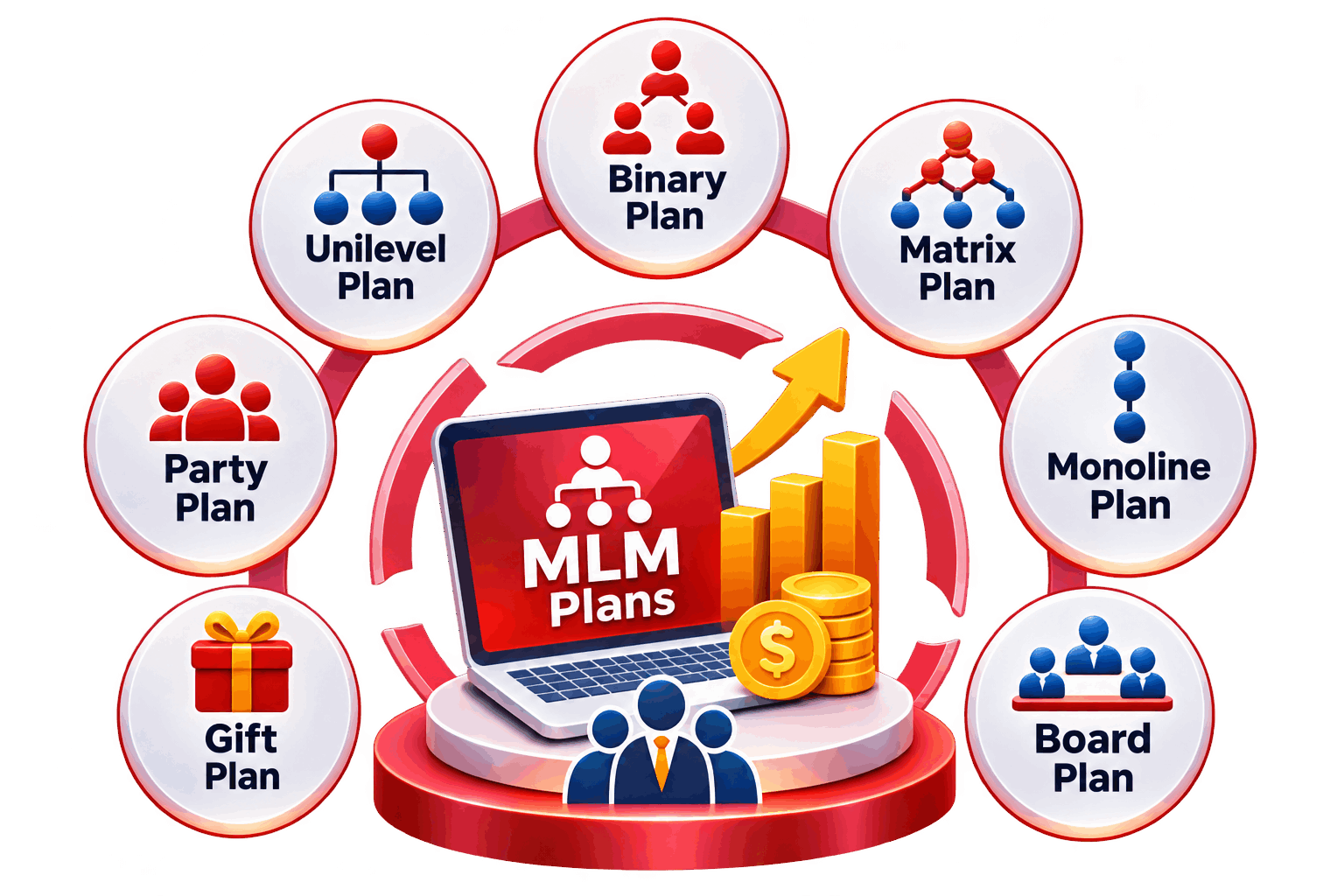
Each plan uses a different network structure and commission calculation method. Some focus on team-based sales volume, while others use multiple levels, fixed positions, or combined structures.

Binary MLM Plan
A Binary MLM Plan is a compensation structure in which every distributor can build two teams, commonly known as the left leg and right leg. Distributors develop both teams by sponsoring new members and expanding their respective networks.
Commissions are generally calculated based on eligible business volume generated by the two legs. Depending on the compensation rules, businesses may also offer carry-forward volume, matching bonuses, and other incentives.
Key Features:
- Two-leg team structure
- Left and right team volume tracking
- Pair-based commission calculations
- Carry-forward options based on business rules
- Performance-based bonuses and rewards
Who Is It Suitable For?
Businesses that prefer a two-team structure with balanced team development and volume-based commission calculations.

Unilevel MLM Plan
A Unilevel MLM Plan allows distributors to sponsor an unlimited number of members directly under their positions. All directly sponsored members form the first level, while their sponsored members become subsequent levels in the network.
Unlike a Binary Plan, the Unilevel structure does not restrict the number of direct referrals. Commissions are calculated according to eligible sales or business volume across the levels defined by the company.
Key Features:
- Unlimited direct referrals
- Multiple levels of distributor networks
- Level-based commission calculations
- Flexible commission percentages
- Suitable for different team-building strategies
Who Is It Suitable For?
Businesses that want to provide distributors with the flexibility to sponsor multiple members directly and develop wider networks.

Matrix MLM Plan
A Matrix MLM Plan is a structured compensation model where distributors are placed within a predefined width and depth. For example, a 3×3 matrix allows three direct positions per distributor across three levels.
When the available positions in a distributor’s matrix are filled, additional members may be placed in deeper positions through a placement or spillover mechanism, depending on the company’s rules.
Key Features:
- Fixed width and depth
- Structured distributor placement
- Spillover functionality
- Level-based commission distribution
- Matrix completion rewards based on business rules
Who Is It Suitable For?
Businesses that prefer a predefined network structure with controlled placement and depth-based commission management.
Monoline MLM Plan
A Monoline MLM Plan follows a single-line distributor structure in which members are arranged sequentially, one after another. Each new distributor is placed in the same continuous line rather than being divided into multiple legs or branches.
Commission eligibility is determined by the company’s placement, sales, and payout rules. Businesses can configure the structure to support their specific compensation strategy.
Key Features:
- Single-line network structure
- Sequential distributor placement
- Simplified network tracking
- Configurable commission rules
- Centralized distributor management
Who Is It Suitable For?
Businesses looking for a straightforward, single-line network structure with clearly defined placement and commission rules.
Board MLM Plan
A Board MLM Plan is a compensation structure in which distributors are placed on a predefined board. When the required positions are filled, the board completes according to the company’s compensation rules.
Depending on the board structure, distributors may move to another board or become eligible for specific rewards after completing a cycle.
Key Features:
- Predefined board positions
- Board completion tracking
- Cycle-based reward distribution
- Distributor movement between boards
- Configurable board levels and rewards
Who Is It Suitable For?
Businesses that use cycle-based compensation structures and want to manage board positions, completion conditions, and reward distribution.
Gift MLM Plan
A Gift MLM Plan is a network-based compensation structure that operates through predefined gift contributions, distribution rules, or gifting cycles. Participants are placed within a structured network, and gift distribution follows the conditions established by the business.
The actual participation, contribution, and distribution rules depend on the specific business model and applicable legal requirements.
Key Features:
- Structured participant placement
- Configurable gifting rules
- Cycle and position tracking
- Automated transaction records
- Customizable distribution conditions
Who Is It Suitable For?
Businesses exploring gifting-based network structures, subject to applicable financial, consumer protection, and direct-selling regulations.
Hybrid MLM Plan
A Hybrid MLM Plan combines two or more compensation structures into a single business model. For example, a business may combine Binary and Unilevel structures to create a compensation system that supports different commission methods.
The combined structure allows businesses to configure network placement, commission calculations, bonuses, and qualification conditions according to their requirements.
Key Features:
- Combination of multiple MLM structures
- Flexible commission configurations
- Multiple income calculation methods
- Customizable distributor placement
- Integrated network and performance tracking
Who Is It Suitable For?
Businesses that require a customized compensation structure instead of relying on a single traditional MLM plan.
Australian X-Up MLM Plan
An Australian X-Up MLM Plan is a compensation structure in which distributors pass a predefined number of commissions or positions to their upline sponsors before becoming eligible to receive their own earnings. The X-Up value determines how many eligible positions or levels are passed upward, depending on the company’s compensation rules.
This structure focuses on predefined sponsor relationships and commission distribution, with earnings calculated according to the configured X-Up conditions.
Key Features:
- Predefined X-Up commission rules
- Upline-based commission distribution
- Configurable X-Up levels
- Automated position and commission tracking
- Customizable earning and qualification conditions
Who Is It Suitable For?
Businesses that want to implement an upline-focused compensation structure with predefined commission-sharing and position-based rules.
Party Plan MLM
A Party Plan MLM is a direct-selling business model in which distributors organize product demonstrations, social gatherings, or online events to introduce and sell products to potential customers. These events create opportunities for product promotion, customer engagement, and order generation.
Distributors may earn commissions from eligible product sales, party bookings, or team performance, depending on the company’s compensation structure.
Key Features:
- Party-based product promotion
- Online and offline event management
- Customer and order tracking
- Distributor sales management
- Configurable sales commissions and incentives
Who Is It Suitable For?
Businesses that sell products through home parties, group demonstrations, social events, and online product presentations.
Comparison of Different MLM Plans
| MLM Plan | Network Structure | Commission / Earning Method | Advantages | Limitations | Best Suited For |
|---|---|---|---|---|---|
| Binary | Two teams – Left and Right | Eligible business volume from both legs | Simple two-team structure; encourages balanced team growth | Earnings may depend on weaker-leg performance and matching rules | Businesses focused on two-team network building |
| Unilevel | Unlimited direct referrals with multiple levels | Level-based commissions | Flexible recruitment; no limit on direct referrals | Managing deeper networks and commission levels can become complex | Businesses looking for flexible network expansion |
| Matrix | Fixed width and depth | Level commissions and matrix rewards | Defined structure; predictable placement limits | Limited frontline positions; spillover rules may affect placement | Businesses that prefer structured network growth |
| Monoline | Single continuous line | Predefined placement and payout rules | Simple single-line structure; easy to track placements | Limited structural flexibility; earning potential depends on configured rules | Single-line network models |
| Board | Predefined board positions | Board completion and cycle-based rewards | Clear completion targets; structured participant movement | Cycle completion may depend on participant activity and board rules | Businesses using cycle-based compensation |
| Gift | Structured gifting network | Gift distribution based on configured rules | Simple gifting-based participation model | May involve regulatory, legal, and sustainability concerns depending on implementation | Businesses considering gifting-based models |
| Hybrid | Combination of multiple compensation structures | Combined commission methods | Flexible design; supports multiple earning methods | More complex to configure, explain, and manage | Businesses requiring customized compensation structures |
| Australian X-Up | Upline-based position or commission passing | X-Up-based commission distribution | Encourages upline support; follows predefined passing rules | Distribution depends on specific X-Up conditions and participant activity | Businesses using upline-focused compensation models |
| Party Plan | Product demonstrations, parties, and social selling events | Product sales and event-based incentives | Encourages personal interaction; supports product demonstrations | Depends on event participation, customer engagement, and sales activity | Event-based direct-selling businesses |
How to Choose the Right MLM Compensation Plan?
Choosing a plan influences how distributors build their networks and how the business distributes commissions. Consider these factors first:
Business Model
Understand your products, services, target audience, and network marketing strategy.
Team Structure
Decide between two-leg teams, unlimited direct referrals, fixed-width networks, or a combination.
Commission Rules
Define how commissions, bonuses, incentives, and qualification conditions will work.
Business Scalability
Check the structure can support your expected distributor growth and transaction volume.
Software Requirements
Choose software that accurately manages positions, volume, commissions, and payouts.
The right plan should align with your business operations while keeping compensation rules transparent and easy for distributors to understand.
Manage Different MLM Plans with ARM MLM Software
Managing a growing network takes more than a compensation structure. ARM MLM Software tracks registrations, positions, sales, commission eligibility, and payouts on one centralized platform, configured around your rules, whether you run Binary, Unilevel, Matrix, Monoline, Board, Gift, or Hybrid.
Multiple MLM Plans
Support different compensation structures based on business requirements.
Automated Commission Calculations
Calculate eligible commissions according to configured rules.
Genealogy Management
View and manage distributor networks and placement structures.
E-Wallet Management
Track eligible earnings, credits, and debit transactions.
Sales and Performance Tracking
Monitor business volume, activities, and sales performance.
Payout Management
Manage commission settlements according to configured payout conditions.
Customizable Business Rules
Adapt the system to your compensation requirements.
Want to Test Your MLM Compensation Plan Before Launching?
Calculate commissions, explore different payout scenarios, and understand how your compensation structure performs before introducing it to your distributors.
Binary MLM Calculator
Estimate potential commissions in a two-leg structure using eligible business volume, pair matching, and weak-leg calculations.
Try Binary CalculatorMatrix MLM Calculator
Explore commission calculations based on fixed matrix structures, including different width and depth combinations.
Try Matrix CalculatorUnilevel MLM Calculator
Estimate level-based commissions across multiple distributor levels based on your configured compensation rules.
Try Unilevel CalculatorHow to Choose the Right MLM Plan for Your Business
Consider your products, pricing, sales strategy, distributor network, and long-term growth objectives before selecting a structure.
Evaluate Your Products and Pricing
Your product type and profit margins influence how much commission your business can sustainably offer.
- Recurring products may work well with Unilevel or Generation-based structures.
- Products with different sales volumes may suit Binary or Matrix models, depending on the commission rules.
- Ensure product pricing supports commissions, operating costs, and business expenses.
- Consider repeat purchases and customer retention when designing payouts.
Understand Distributor Behaviour
Think about how distributors will promote products, build teams, and engage with customers.
- Sales-focused networks may benefit from Unilevel or Party Plan models.
- Team-building strategies may consider Binary or Matrix structures.
- Businesses with different distributor roles may explore Hybrid plans.
- Choose a structure that distributors can understand and follow.
Plan for Business Growth
Your compensation structure should support your expected network size and expansion strategy.
- Consider Unilevel for flexible frontline recruitment.
- Explore Matrix for predefined width and depth.
- Evaluate Binary for two-team network development.
- Consider Hybrid when your business requires a combination of compensation structures.
Consider Operations and Compliance
A compensation plan must be practical to manage and aligned with applicable regulations.
- Ensure your MLM software supports all commission rules and payout conditions.
- Define placement, spillover, bonus, and eligibility rules clearly.
- Review local direct-selling and consumer protection regulations in your target markets.
- Keep the plan transparent and easy for distributors to understand.
MLM Compensation Solutions for Different Industries
ARM MLM Software supports businesses across industries with configurable compensation plans, helping them manage distributor networks, track sales, and automate commission calculations.
E-commerce and Retail
Manage product-based network marketing, distributor sales, order tracking, and commission calculations.
Health and Wellness
Support networks selling wellness products, supplements, and personal care items with structured commission management.
Beauty and Cosmetics
Manage product distribution, repeat purchases, sales performance, and distributor commissions.
Education and E-Learning
Support referral-based education businesses, online course subscriptions, and membership-based sales.
Real Estate
Manage referral networks, sales-linked incentives, and commission distribution based on configured rules.
Travel and Hospitality
Organize referral-based travel services, membership programs, bookings, and eligible sales commissions.
Financial Services
Manage eligible referral networks and incentive structures while considering applicable financial regulations.
Digital Products and Services
Support digital subscriptions, software products, online services, and membership programs.
Benefits of Network Marketing Software
Managing a growing distributor network involves tracking sales, calculating commissions, monitoring team performance, and handling payouts. Network marketing software brings these activities into one system, helping businesses manage daily operations and their compensation plans more efficiently.
Automated Commission Calculations
Calculate commissions, bonuses, and incentives based on configured compensation plan rules. Reduce manual calculations and improve payout accuracy.
Centralized Distributor Management
Manage distributor profiles, referral relationships, team structures, and account activities through a centralized platform.
Real-Time Business Tracking
Monitor sales volume, distributor performance, team progress, and commission records through reports and dashboards.
Flexible Compensation Plan Management
Configure different MLM structures, including Binary, Unilevel, Matrix, Board, and Hybrid plans, according to your business requirements.
Simplified Payout Management
Track eligible commissions, payment records, and payout statuses while making the commission distribution process easier to manage.
Improved Distributor Experience
Provide distributors with access to their personal dashboards, referral details, sales information, earnings, and team performance.
Scalable Business Operations
Support business expansion with software that can manage growing distributor networks, transaction volumes, and operational requirements.
Better Reporting and Business Insights
Use business reports and performance data to understand sales trends, evaluate network activity, and make informed decisions.
Why Choose ARM MLM Software?

Choosing the right MLM software is essential for managing distributor networks, implementing compensation plans, and streamlining daily business operations. With experience in MLM software development since 2013, ARM MLM Software offers configurable solutions that support different compensation structures, including Binary, Unilevel, Matrix, Monoline, Board, Gift, Hybrid, and customized plans. Businesses can configure commission rules, bonus calculations, distributor placement, and payout conditions according to their specific requirements.
ARM MLM Software brings distributor management, referral tracking, sales monitoring, and commission calculations together in one platform. It also supports integrations with payment gateways, e-commerce platforms, and third-party applications to simplify business operations. With web and mobile accessibility, centralized reporting, and technical support, ARM helps businesses manage their network marketing activities and adapt their software to changing operational requirements.
Looking for MLM Software for Your Compensation Plan?
Get in touch with ARM MLM Software to discuss your business requirements and explore a suitable solution.
Frequently Asked Questions
What are the different types of MLM plans?
The common types include Binary, Unilevel, Matrix, Monoline, Board, Gift, and Hybrid plans. Each uses a different network structure and commission calculation method.
Which MLM plan is best for a network marketing business?
There is no single best plan. The right choice depends on the business model, product strategy, distributor network, commission rules, and growth objectives.
What is the difference between Binary and Unilevel MLM plans?
A Binary plan lets each distributor build two teams, usually the left and right legs. A Unilevel plan lets distributors sponsor unlimited direct members, with commissions generally calculated across eligible network levels.
What is a Hybrid MLM Plan?
A Hybrid plan combines two or more compensation structures, such as Binary and Unilevel, into one business model, allowing different commission methods based on your requirements.
Can I customize my MLM compensation plan?
Yes. A plan can be customized for network structure, commission percentages, qualification conditions, bonuses, and payout rules. The available customization depends on the software solution.
How does MLM software manage different compensation plans?
It manages distributor registration, network placement, sales tracking, commission calculations, bonuses, e-wallet transactions, and payout processing according to the selected plan.
